
Short Selling / Stock Locate Search
Find out current selling short locate rates, whether a stock is hard to borrow, easy to borrow (ETB),
on the threshold list, short sell restricted and whether it is easy to short a stock at SpeedTrader.
Why active traders choose SpeedTrader?
Speed and Efficiency
- Locate and short in seconds.
- SpeedTrader Pro
powered by DAS Trader
Low Locate Costs
- No cost locates.
- Many easy to borrow stocks.
- Very competitive rates.
Exceptional Availability
- 4am to 8pm.
- Ten+ locate venues.
- Looking for a hard to borrow ticker?
- Need high volume short locate pricing?
- Want real-time locate fee info?
SpeedTrader provides active traders with sophisticated trading tools including an integrated short locate tool built into the trading platform, SpeedTrader Pro powered by DAS Trader Pro. This tool allows traders to send a locate request in the trading platform to our ten+ locate venues simultaneously and receive a response back directly in the platform with the cost displayed in seconds. Traders can either accept or reject the locate. If accepted, the trader is able to immediately enter a short sale order for the stock. Most stocks located are available for re-use intraday, while threshold securities are only available to use once per locate. Short positions held overnight may incur overnight borrow fees. If you have read this far, you have found the right firm. We cater to active long and short traders with a high touch personalized service. Ask us about our Elite Trader support program.
Basics of Short Selling Stocks
Looking for the best broker for short selling?
- Based on client feedback, the best brokers for short selling are those that provide a vast range of short locate availability and low prices.
- SpeedTrader provides 12 different third-party short locate providers, has its own short locate desk that continually strives to provide the lowest short locate costs possible.
Can I locate stock pre-market and post-market?
- Yes, SpeedTrader offers locate services through the SpeedTrader short locate desk and through third party locate providers from 4am ET to 8pm ET.
What is shorting a stock?
- Shorting a stock is a trading strategy where a trader thinks a stock’s price is going to decrease in value. To take advantage of this, a trader will sell the stock shares short, with the intention of buying them back later at a lower price and keeping the difference as profit.
How do I short a stock?
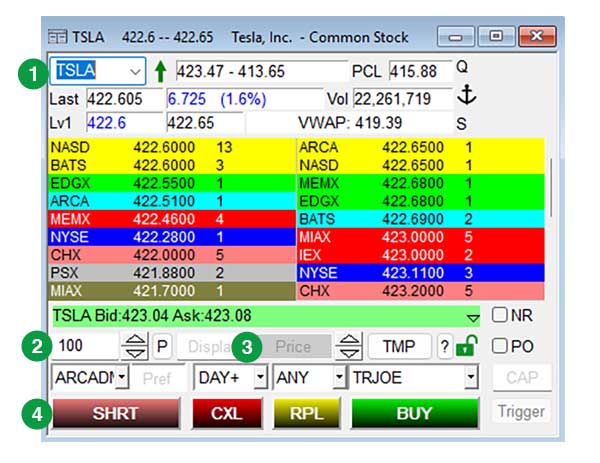
- Open a margin account at SpeedTrader. Fund the account. Log into the trading platform. If the stock is “easy to borrow”, place a sell short order; 1. Enter the symbol. 2. Enter the number of shares. 3. Enter the price. 4. Click the SHORT button.
How do I get out of or cover a short stock position?
- To get out of or cover a short stock position, buy the same number of shares of the stock you are short.
Short Locate and Borrow Availability
Are all stocks shortable because they are “easy to borrow”?
- Not all stocks are easy to borrow for short selling. SpeedTrader categorizes stocks into four groups, “Easy-to-Borrow” (readily available), “Hard-to-Borrow” (limited availability via locates), “Reg SHO/Threshold” (single use limited availability via locates) and “Short Prohibited”. If a stock is not “easy to borrow”, you must first locate shares of stock to sell short.
- The status of each stock is indicated on the level 1 portion of the Montage. If you click on the letters indicated below a detailed info box will pop up.
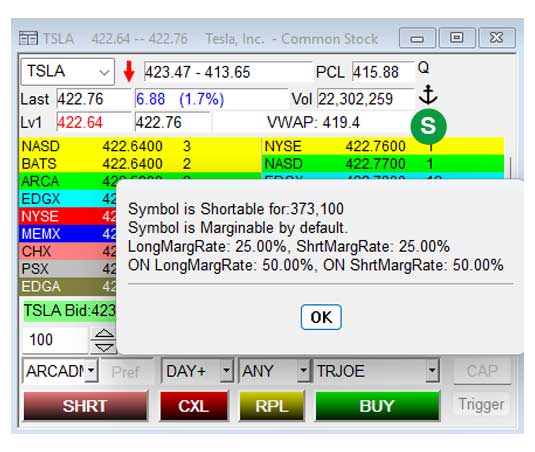
- S = Easy to Borrow (no locate required)
- HTB = Hard to Borrow (locate required – multiple trades allowed)
- RS = Reg SHO Threshold (locate required for each trade or pre-borrow)
- SPB = Short Prohibited (shorting not allowed)
How do I locate shares of stock to sell short at SpeedTrader?
- You can locate shares directly through our trading platform. You input the symbol and share amount, then click “Inquire All”. Your locate request is sent to all 12 of our third party short locate providers. Within seconds, the results will display with availability and prices. If you want to accept a locate offer, click on it and choose “Accept”.
If I locate a stock, can I short it again after I cover it?
- Yes, you can reuse locates for non-Threshold Securities.
Shorting Overnight & Settlement
Can I hold a short stock position overnight?
- Yes, you can hold a short stock position overnight, although you may be subject to a borrow fee. This fee is generally calculated at settlement and can vary based on market conditions.
What is the difference between a short locate and a borrow?
- A short locate indicates that the broker is reasonably able to borrow the shares required to allow shorting. A short borrow is the actual process of borrowing long shares from a third party and acquiring the long shares to cover an overnight short position. Locates are generally used for day trading and short borrows are for overnight short positions.
Short Locate Fees & Borrow Costs
What is a short locate fee?
- A short locate fee is a cost paid to a broker to borrow shares of a Hard to Borrow stock, enabling a trader to execute a short sale. These fees are charged on a per-share basis regardless of whether the trade is actually executed or not.
What are borrow costs?
- Borrow costs for stocks are fees paid by short sellers to borrow shares from lenders, typically via brokers, when holding a short position overnight. These fees are usually expressed as an annual percentage rate (APR) based on the total value of the borrowed shares, assessed daily, including weekends.
Do I have to pay for short locates and a short borrow fee?
- For day trading, only a short locate fee is charged. If you hold stock short overnight, you will pay the locate fee when initially shorting the stock and an overnight borrow fee, typically starting on the day the short trade settles, and each day until the day your buy to cover settles.
Why was I charged an overnight borrow fee on the first night I held a non-easy to borrow stock short overnight?
- In some cases, clearing firms may pre borrow shares before settlement due to limited availability, resulting in an overnight borrow fee earlier than expected.
Is short selling stocks expensive?
- Short selling can be very expensive and carries high risks compared to traditional investing. Costs include annual borrowing fees, sometimes over 100% to 1,000% or more for hard-to-borrow stocks, margin interest, and liability for dividends. While popular stocks are generally cheap to short, others have steep fees that can erase profits.
What happens if I am short a stock that halts for multiple days?
- Your account will remain short the shares until the stock starts trading again, and you execute a buy to cover trade. Borrow fees continue to apply to halted stocks.
Why do I have to pay borrow fees for a halted stock?
- You pay borrow fees for a halted stock because you are still utilizing borrowed shares. A trading halt does not cancel your short position or return the shares to the lender. Borrow fees are charged daily to maintain the ability to keep that position.
Why did I get charged a borrow fee the day after I closed my short position?
- If you hold a stock short on Thursday night, you will be charged borrow fees for Friday, Saturday and Sunday.
Why did I get charged borrow fees over the weekend?
- If you hold a stock short on Thursday night, you will be charged borrow fees for Friday, Saturday and Sunday.
Why did I get charged borrow fees over the weekend, I closed my short position on Friday?
- Settlement is T+1 (trade date plus one business day). So, the earliest the buy on Friday will settle is Monday. In this instance, borrow fees are charged for Friday, Saturday and Sunday.
Regulation SHO/Threshold Securities/Short Sale Prohibited (SSR)
What is Reg SHO?
- Regulation SHO (Reg SHO) is a Securities and Exchange Commission (SEC) regulation implemented in 2005 to update and govern short-selling practices, primarily targeting “naked” short selling and persistent failures to deliver shares. It mandates that brokers locate borrowable shares before selling, enforces strict close-out requirements for failures to deliver, and imposes a “circuit breaker” on shorting stocks that drop >10% in a day.
What is a Threshold Security?
- A threshold security is a stock with high, persistent “fails to deliver” defined as 10,000 shares or more, or more than 0.5% of outstanding shares, for five consecutive settlement days, signaling potential naked short selling. These securities are published on lists by exchanges to monitor market manipulation and maintain stability.
Can I short a Threshold Security at SpeedTrader?
- Yes, if you locate the stock, you can short it once per locate. If you want to short it again, you need to locate it a second time. OR, if you choose the SpeedTrader “Pre-Borrow” feature and successfully pre-borrow a threshold stock you can short the stock again after you cover it.
What is Short Sale Restricted (SSR)?
- A Short Sale Restriction (SSR), often referred to as the “Alternative Uptick Rule” (Rule 201), is a Securities and Exchange Commission (SEC) rule adopted in 2010 that states when a stock drops 10% or more from the previous day’s close, short selling is restricted to upticks. Meaning you can only short at a price higher than the current best bid. When triggered, it lasts for the rest of the day and through the following day.
Fail to Deliver and Buy-In’s
What is a Fail to Deliver?
- A Fail to Deliver (FTD) occurs when a seller fails to deliver securities to the buyer by the settlement date. typically, T+1 (one business day after the trade). When a trade occurs, the seller has one day to deliver the shares, and the buyer has one day to pay. If the seller doesn’t have the shares, they are in a “short fail”. The SEC tracks this via the Fails-to-Deliver Data.
What is a Buy-In?
- If a broker cannot deliver shares, the buyer’s broker can initiate a “buy-in,” forcing the purchase of shares to cover the failure, often at the expense of the original seller.
Short Selling Risks
Is short selling stocks risky?
- Short selling stocks is considered high-risk, as losses can be unlimited if the stock price rises. Unlike long investments where risk is limited to the initial investment, theoretically a stock price can go up to infinity, resulting in unlimited losses.
Are their additional risks in shorting stocks?
- Short Squeeze Risk – If a heavily shorted stock rises sharply, shorts are forced to buy to cover, driving the price even higher and causing massive, rapid losses.
- High Borrow Fee Risk – Short sellers must pay interest on the borrowed shares. These fees can increase suddenly, sometimes to thousands of a percent, for highly volatile and low volume stocks.
- Stock Halt Risk – Shorting a stock that gets halted can result in high borrow fees being charged every day, until the stock trades and is covered, for extended periods.
- Dividend Risk – Short sellers are responsible to pay out any dividends.
- Margin Call Risk – Shorting requires a margin account. If the price goes up, a broker may demand more cash, forcing a loss or forcing the liquidation of other assets.
- Timing Risk – Even if the company is fundamentally weak, a stock can remain overvalued or irrational for longer than a short seller can stay solvent.
- Other risks may apply.
No information provided by SpeedTrader, directly or indirectly, should be considered a recommendation or solicitation to adopt any particular trading or investment strategy, or to invest in, or liquidate, a particular security or type of security. Information provided by SpeedTrader on its Twitter, Facebook or Blog pages is for informational and educational purposes only and is not intended as a recommendation of any particular security, transaction or strategy. Commentary and opinions expressed are those of the author/speaker and not necessarily those of SpeedTrader. SpeedTrader does not guarantee the accuracy of, or endorse, the statements of any third party, including guest speakers or authors of commentary or news articles. All information regarding the likelihood of potential future investment outcomes are hypothetical. Future results are never guaranteed. Any examples that discuss potential trading profits or losses may not take into account trading commissions or fees, which mean that potential profits could be lower and potential losses could be greater than illustrated in any example.